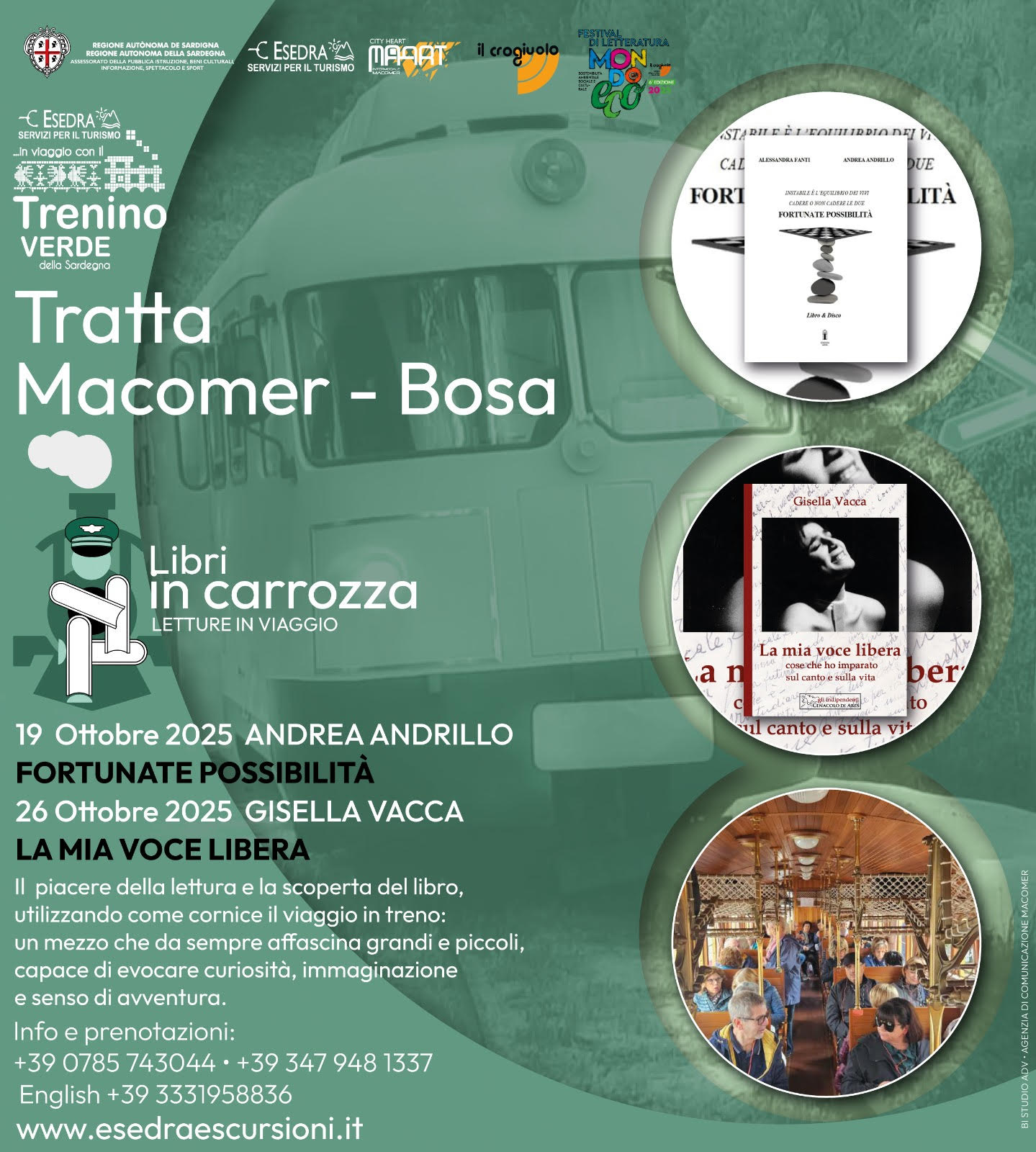
A very special initiative for the previews of the Mondo Eco literary festival, thanks to the collaboration between Il Crogiuolo and the Esedra Escursioni cooperative, the “Books in Carriage” initiatives are kicking off. On the Macomer-Bosa stretch of the Trenino Verde della Sardegna (Sardinia’s Little Green Train), it will be possible to meet authors and artists. The first two initiatives combine these qualities in the same people, namely Andrea Andrillo and Gisella Vacca. The program begins on Sunday, October 19, 2025, with “Fortunate possibilita” by Andrea Andrillo and Alessandra Fanti, published by Abba.
like the new word, irresistibly fascinating and prophetic. Because here we find neither consolatory parables nor incontrovertible determinations, even when we find ourselves among the samurai, who travel with death at their side, or the turkeys, whose shrill cries match their frustrating attempts at flight. We find (apropos again) the immanence of a vision that tenaciously traverses the significant edges of many languages, regenerated in a sung form inextricably linked to a played form (a compositional ferment welded, with a few exceptions, to the trio form: Silvano Lobina on bass, electric guitars and electronics, Nicola Vacca on drums, and Andrillo on acoustic guitar). Looking more closely, we realize that “Fortunate possibilita” rests, if anything, on a new surface, of which we can recognize some general traits that define its contours. First of all—as we can read in the interview—the singer’s approach to formulate and bring major themes to life: death, the disintegrated and contradictory whole that blends culture, love, horror, life, history, strength, will. There’s the firm belief that form is not substance and that history can also be sung in different ways: “certainly, our society tends to hide death under piles of junk and struggles to consider victorious those who, despite strenuously fighting with courage and enormous dignity, arrive battered at the finish line.” In this sense, the discussion of the Sardinian language is extraordinary, because it leads back to the broader concept of determination (there’s no point in going on about this). But above all, because it overturns the paradigm of localism, and with it, isolation at all costs: Andrillo moves ahead, indeed defining his poetics through a “safe” and historical language, while also communicating its movement toward (and through) other languages. This formulation has a profound political meaning, because it brings a song and a vision to our polyglot, polymorphic and postlinguistic contemporary world.
On October 26th, the baton passes to Gisella Vacca, who will take over “My Free Voice. Things I Learned About Singing and Life,” published by Il Cenacolo di Ares.
Since then, I’ve been singing. Joyfully. With all my emotions intact. Singing, among my activities, is what brings me closest to bliss. Certainly, much of this bliss is due to the release of endorphins that singing, through the necessary and specific muscular work, unleashes. Beyond its physiological origin, I believe this pure joy is due above all to the fulfillment of my authentic, primordial existential desire. It’s no coincidence that it germinated during childhood: children know exactly what they want to be when they grow up, but then most get lost in the desires of adults. I, thank goodness, got home in time. Time is subjective: at any moment, you can realize you’re lost; the important thing is to find your way back before you’ve wasted your entire existence. For this reason, it wouldn’t be a bad idea to occasionally consult the child we once were, who lives within us beyond the passing years. We should ask him every now and then what he thinks of the adults we have become.” (the author)
For information and reservations, call 0785 743044 or 3479481337.

