On the night of November 2, 1975, just over five decades ago, the tragic epilogue of Pier Paolo Pasolini’s life took place.
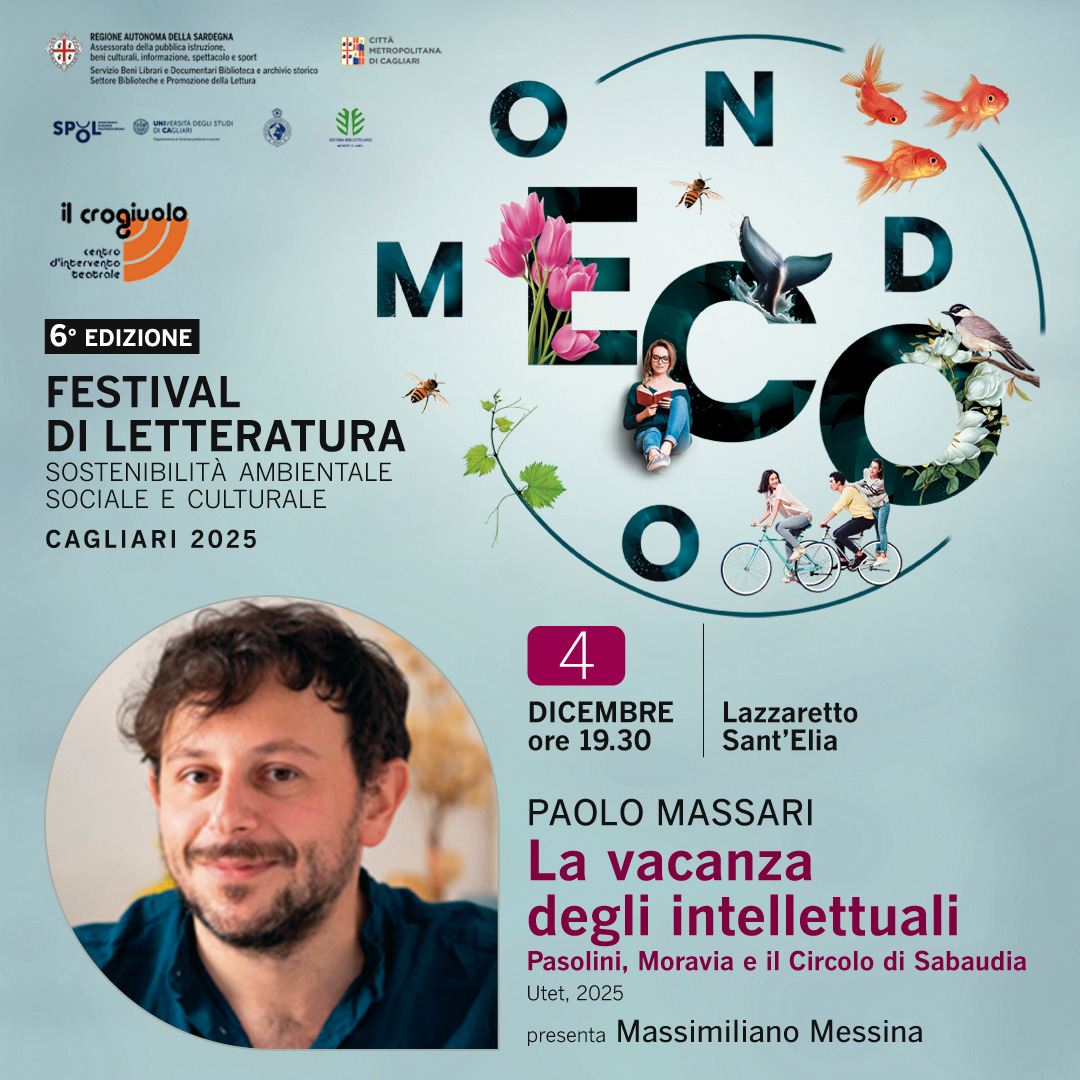
And on Thursday, December 4th, at the Lazzaretto di Sant’Elia, the Mondo Eco festival will commemorate one of the most important, albeit controversial, Italian intellectuals of the last century, certainly one of the most multifaceted: poet, novelist, critic, polemicist, playwright, screenwriter, and film director. At 7:30 pm, writer Paolo Massari – a researcher in Italian Studies at Sapienza University of Rome – will discuss his book “The Intellectuals’ Holiday. Pasolini, Moravia and the Sabaudia Circle” (Utet, 2025). In conversation with him is the journalist and writer, Massimiliano Messina.
“I chose Sabaudia as a spiritual place for my forced rest and my anxieties about future work, furious dreams that keep me anchored to the world.” With these words Pasolini described his relationship with Sabaudia, where he had bought a house together with Alberto Moravia. That place, once a symbol of the fascist regime’s resourcefulness, became a few years later the favorite meeting place of the Italian intelligentsia: thus it was possible to meet Moravia shopping at the fishmonger’s, Bernardo Bertolucci and Ian McEwan discussing the script of a film that was never made, Laura Betti strolling with Dario Bellezza, Jean Genet hunting for signatures on a petition for Palestine. Massari has a privileged perspective: his great-uncle was the founder of the city library, he met the protagonists of this story and conversed with them. Aided by archival documents and the words of witnesses such as Dacia Maraini, Alain Elkann, and Edoardo Albinati, Massari reconstructs the moment when Sabaudia became one of the avant-garde centers of Italian art, cinema, and literature: the focal point from which to observe postwar cultural history.
This will be followed by the recital “The Dream of a Thing. Fifty Years Later, Pasolini,” curated by Massimiliano Messina, in collaboration with the Cineteca Sarda. A sort of “docu-reading,” whose title evokes the first novel by the Bolognese writer, with staged readings by Mario Faticoni (Messina selected the texts, images, and music). Pasolini is remembered above all as a poet, then as a novelist and essayist, but also as a director (as Moravia did in his famous funeral oration): a montage of images from some of his most important films, together with fragments taken from documentaries dedicated to him, accompany the reading.